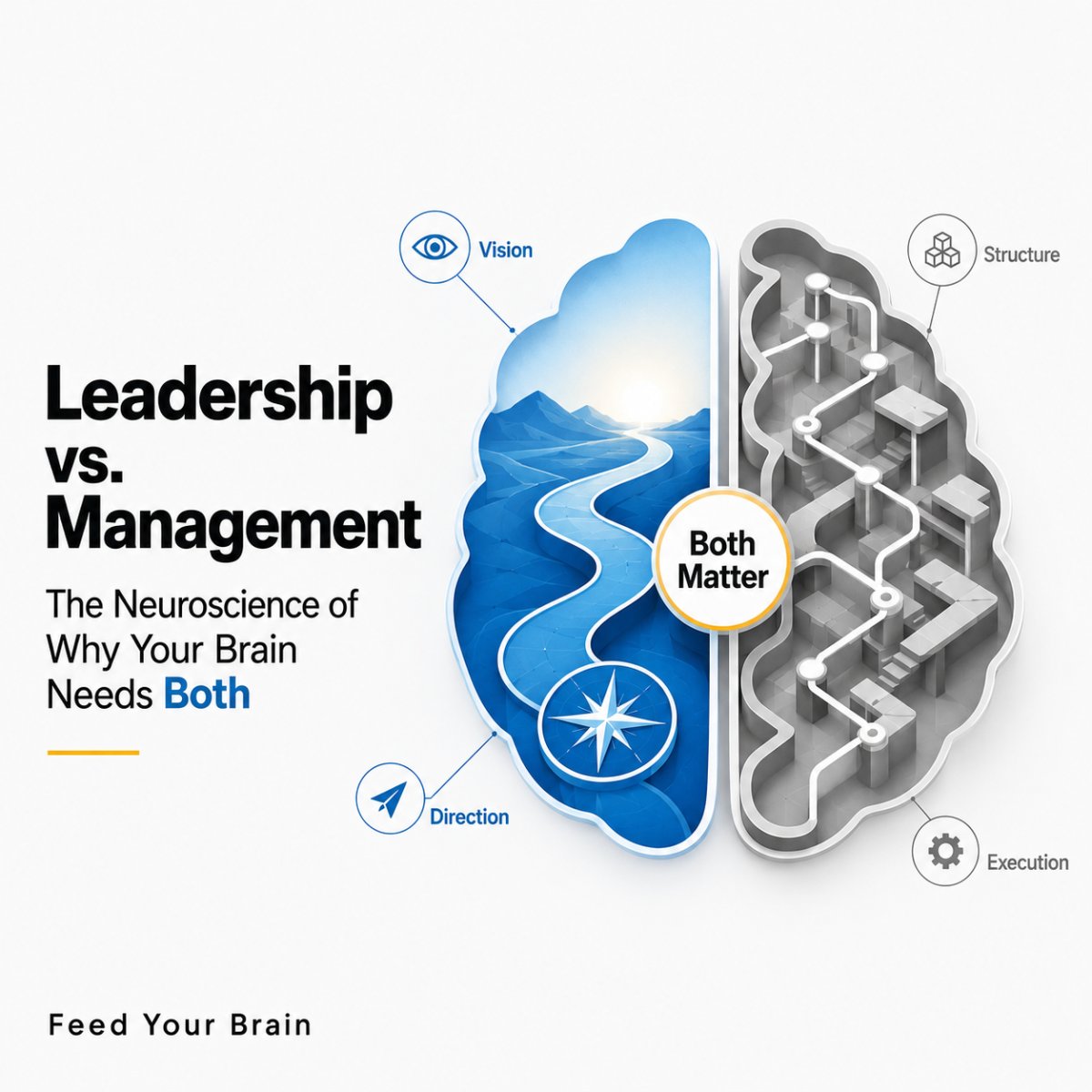
Leadership vs. Management: The Neuroscience of Why Your Brain Needs Both
You cannot set direction for the next three years and chase down an outstanding expense report in the same ten minutes. Most leaders treat that as a discipline problem. It is closer to a capacity problem, and it has a fix.
** **
Leading and managing are different work. One is about running what already exists. The other is about building something that does not exist yet. Both are legitimate, both are necessary, and the exhausting part is not doing either one. It is switching between them, repeatedly, all day, without ever being taught how.
** **
I spent 18 years leading Learning & Development inside a Fortune 500 organization. I watched capable people describe this exact feeling as personal failure. It is not. Once you stop treating the switch as a character trait, it becomes something you can design for.
Key Takeaways
- Managing complexity and leading change are different jobs, and neither one is a personality type.
- The switch between them is the actual skill, and almost nobody is trained in it.
- Your working memory holds far less than your calendar assumes, which is why both modes cannot run at once.
- Your team's resistance to a new direction is usually a request for predictability, not an objection to your plan.
- What you talk about repeatedly is not commentary on the work. It is part of the work.
Why the Leadership vs. Management Debate Is Really a Capacity Question
Leaders arrive at my workshops describing the same week. They meant to work on strategy. Instead, they spent four days clearing a queue that regenerated behind them. Ask what went wrong, and most say they were too busy to lead. They are treating it as a calendar problem.
** **
Take the pressure seriously before treating it as a personal shortcoming. Gallup's State of the Global Workplace 2026 found global manager engagement has fallen to 22%, down from 31% in 2022. Gallup frames that as a broad decline rather than one with a single cause. It still tells you the role has gotten heavier. You are not imagining the weight.
** **
The volume of change is part of why. Roughly 85% of senior executives say their number of change projects rose significantly over five years. Change is judged successful only about 31% of the time (Harvard Business Review, 2023). More change, landing worse, on managers with less left in the tank.
** **
The distinction underneath it is simple. Management handles complexity. Its questions are how and when. Leadership handles change. Its questions are why and what next. Both belong in the job. The difficulty is that they compete for the same limited attention, and one of them is much easier to reach for.
Why the Familiar Mode Usually Wins
Management is mostly retrieval. You are running routes you have already built. That is what makes it efficient, and why it is the default when you are tired. It also produces something visible by the end of the day, and visible progress is genuinely satisfying.
** **
Leadership does not offer that. You are building a path rather than following one; the feedback arrives months later, and there is no queue to clear at the end. When both are available, and you are depleted, the one with the faster payoff wins. That is not weak discipline. That is a predictable response to how the two kinds of work are structured.
The Real Reason You Cannot Hold Both
Here is the part most leadership advice skips. Your working memory holds only about three to five things at once. That is not a metaphor. It is one of the more replicated findings in cognitive psychology, and the NeuroLeadership Institute points at it as the practical limit behind modern overload.
** **
Look at what a normal management morning consumes: the escalation, the staffing gap, the number that moved the wrong way, the message you have not answered. That is the whole allocation. Nothing is left for the question with no deadline attached, which is why strategy keeps sliding into a quieter week that never arrives.
** **
Task-switching makes it worse, because every jump between modes carries a cost you do not see on the calendar. Twelve fragments of a day are not the same resource as two protected blocks, even when they add up to identical hours.
** **
This is also why AI has not delivered the breathing room people expected. Rather than reducing load, it often intensifies it. People end up more engaged and simultaneously buried under a higher volume of tasks (Harvard Business Review, 2026). Filling every recovered minute with another prompt does not create space to think. It removes the last of it.
** **
One small shift: Take one recurring meeting this week and remove the agenda. Without a checklist to work through, the conversation has to go somewhere else.
Why Your Team Hears a Threat Instead of a Plan
When you announce a change, people don't evaluate your strategy first. They are working out what it means for them. That happens before the analysis does, and no amount of logic reaches someone who has not gotten past it yet.
** **
The SCARF® model, developed by David Rock at the NeuroLeadership Institute, is a useful checklist for what people are scanning: Status, Certainty, Autonomy, Relatedness, and Fairness. A change that threatens any one of those five reliably produces pullback. It looks like resistance to the plan when it is really a response to the loss.
** **
Certainty is the one leaders undercut most often, usually by accident. "We will share more when we know more" is honest and it lands as nothing. You do not need every answer. You need to say what happens next and when the next update arrives, and then actually send it.
** **
| Dimension | Management | Leadership |
|---|---|---|
| The work | Running what exists | Building what does not exist yet |
| Feedback | Immediate and visible | Delayed, often by months |
| Daily focus | The how and the when | The why and the what next |
| Failure mode | Never getting out of the queue | Direction nobody acts on |
** **
One small shift: The next time you announce a change, name one thing that is not changing. People need something stable to hold before they can engage with what is moving.
The Leader Habit That Actually Moves This
This is the finding that changed how I think about the whole problem.
** **
The NeuroLeadership Institute reports that when managers increase how often they discuss concepts like growth mindset or SCARF, their people report feeling 15% to 25% more equipped to apply new habits based on them. That comes from NLI's own client data rather than an independent study, so hold it as directional. The direction is still worth sitting with.
** **
The intervention is not the training. It is the manager talking about it, repeatedly, in ordinary conversation.
** **
That reframes what leadership work even is. Most leaders treat the language part as overhead, the stuff you say on the way to the real work. It is closer to the opposite. What you name repeatedly is what your team can actually use. A concept mentioned once in a rollout deck is a concept nobody has access to under pressure. The same concept raised in a normal Tuesday check-in becomes something people reach for.
** **
It also means the switch is cheaper than it looks. You do not need a two-day offsite to lead. You need to bring the language of where you are going into conversations you are already having. This is a large part of why change initiatives fail even when the plan was sound.
** **
One small shift: Pick one idea you want your team operating on. Say it out loud in three separate conversations this week. Not a launch, not an announcement, just three mentions.
Putting It Together
Awareness does not change behavior on its own. I have watched leaders read the research, agree completely, then go back to rewriting a project plan somebody else owned.
** **
The Shift Method is how I work this in practice, and it is five steps. Identify the moment you drop into task mode when you meant to lead. Question whether the pull is about the work, or about the discomfort of leaving something unresolved. Reframe the switch as a decision you make rather than a discipline you lack. Build a clear Vision of a week where both modes have real space. Then Act on one small, repeatable change, practiced where you actually work.
** **
That last step carries most of the weight. Move a cue somewhere more visible. Remove a trigger that pulls you backward. Replace one routine with a slightly better one. None of it is dramatic, and that is the point. A change small enough to feel unthreatening is a change you will keep.
** **
Want a structured place to start? The Shift Scorecard is a free four-minute read on where your current setup works against you.
Step Out of the Weeds
The grind pulling you away from the work you want to do is not a character flaw. Management is efficient, familiar, and rewarding on a same-day basis. Leadership is slower, quieter, and easy to postpone. You will not eliminate that tension. You can stop losing to it by accident.
** **
I spent 18 years in Fortune 500 Learning & Development. I am an Amazon bestselling co-author of Strength with Kathy Ireland, and a NeuroLeadership-trained brain-based coach. What I have learned is that leaders who handle this well are not the ones with more discipline. They are the ones who built a structure that does not require any.
** **
If you want to build that with your team, Feed Your Brain | Consulting is built for exactly this. If you want the weekly version of this thinking, The Rewire is free.
** **
Ready for your Shift?
Frequently Asked Questions
Is leadership a natural talent or a skill you can build?
Far more trainable than most people assume. Temperament gives some people a head start, but the actual skill is switching deliberately between two kinds of work, and that improves with practice like anything else. In 18 years of Learning & Development work, I watched self-described pure operators become genuinely strategic leaders. What changed was their routines, not their personality.
** **
Can you be a strong leader without being a good manager?
You can for a while, and then it catches up with you. Leadership supplies the direction. Management supplies the predictability people need to act on it. Without that, your team stays in a low-grade state of not knowing what comes next, and that state is expensive for everyone.
** **
How does a team respond when leadership changes?
People start working out what it means for them before they evaluate anything the new leader says. Until they have some answer, performance tends to dip regardless of how strong that leader is. The transitions I have seen go well share one thing. The new leader names the uncertainty directly and sets a rhythm of communication people can rely on.
** **
Why is strategic thinking more tiring than task work?
Partly because you are building rather than retrieving, and partly because the payoff is months away instead of the same afternoon. Working memory is limited to roughly three to five things at once, and a normal management morning consumes all of it. Nothing has gone wrong when strategy feels harder to reach by 3pm.
** **
Can understanding how people respond to change reduce resistance?
Yes, mostly by changing what you do about it. Read resistance as a request for predictability rather than an objection, and you stop arguing and start supplying information. Clear next steps, plus an explicit statement of what is not changing, lower the cost of the transition.
** **
What should a new manager focus on first?
Notice which cues pull you back into doing the work yourself. New managers default to individual contribution because it is familiar and visibly productive, and that combination is hard to give up. Replace one of those tasks each day with a conversation that develops someone else. It will feel less productive for several weeks, and then it will not.
** **
How do I stop defaulting to task mode when I need to think strategically?
Change something physical. Stay at the same desk with the same inbox open and there is no signal to switch. Move to a different room, close the laptop, or block time where your usual triggers cannot reach you.
** **
Does talking about these ideas with my team actually do anything?
It appears to do more than most leaders expect. NLI's own data suggests people feel meaningfully better equipped to use a concept when their manager brings it up often, rather than once at a launch. Treat repetition as part of the work rather than as filler around it.
SCARF® is a registered trademark of NeuroLeadership Institute, Inc. or its affiliates. Feed Your Brain is not affiliated with or endorsed by the NeuroLeadership Institute.