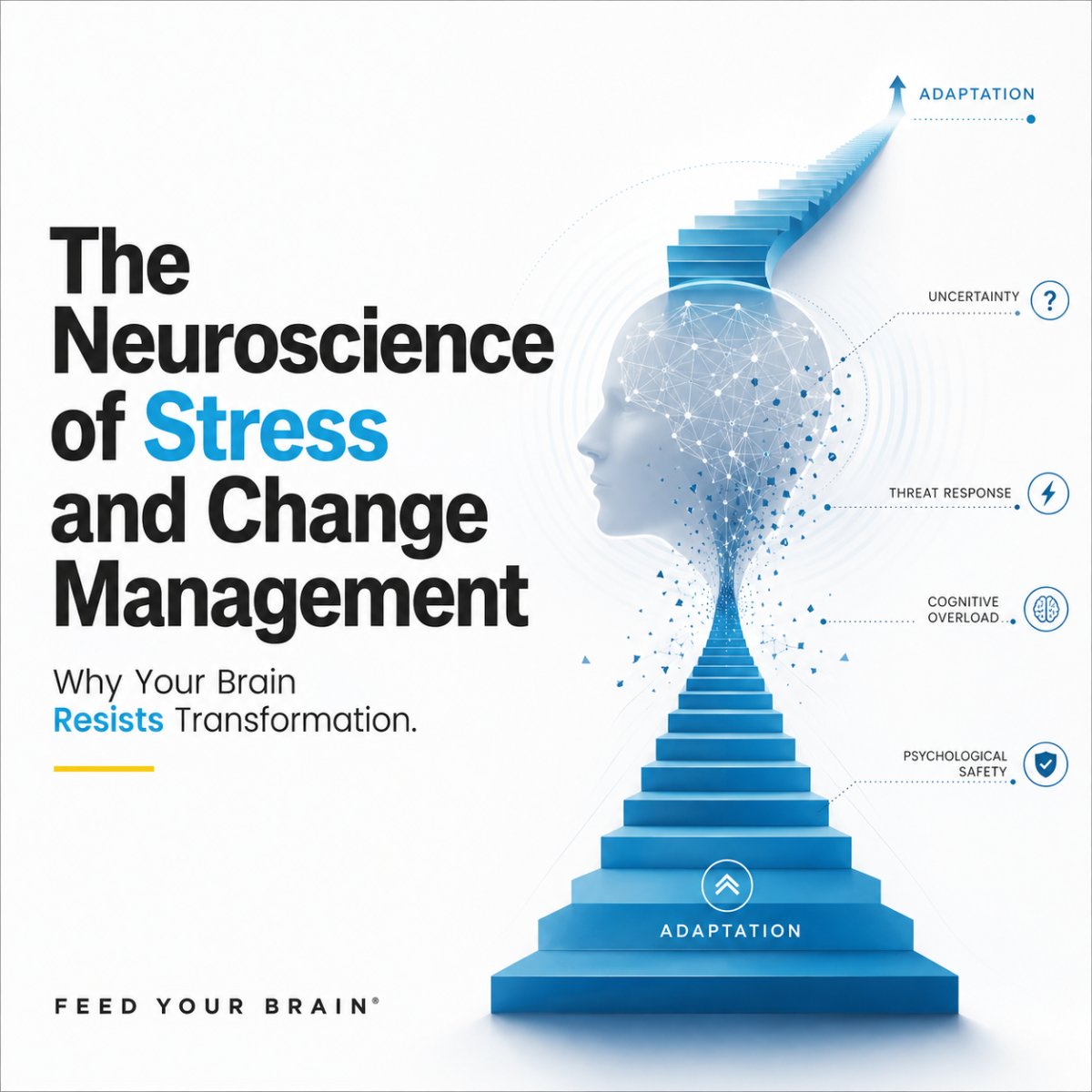
The Neuroscience of Stress and Change Management: Why Your Brain Resists Transformation
Half of U.S. employees report significant daily stress, the highest rate of any region Gallup tracks worldwide. You've likely felt that tension during your last organizational shift. You present a clear, well-reasoned plan for a new AI tool or a structural change. Your team nods. They agree with the "why." Then execution stalls anyway.
This isn't a performance problem or a lack of buy-in. It's biology. Once you look at the actual neuroscience of stress and change management, you see the brain treating uncertainty as something close to a physical threat.
I've spent 18 years in Fortune 500 leadership watching strong strategies stall because they didn't account for how the brain actually processes transition. Leading through constant friction is exhausting, and you want your transformation to stick without burning your people out. Here's what's actually happening biologically, and a real way to work with it instead of against it.
Key Takeaways
Your brain processes organizational uncertainty as a genuine threat, and predictability is the direct antidote.
Knowing a new strategy and actually living it out happen in two different systems in the brain, which is why agreement rarely turns into action on its own.
High stress physically limits the part of the brain your team needs for innovation and adopting new tools.
Small, targeted shifts to environmental cues bypass resistance far more reliably than one big rollout.
Leadership means providing the predictability people's brains need, not just managing tasks.
Why Change Feels Like a Physical Threat
Your brain's core job is keeping you alive, and it does that largely through prediction. When it can anticipate what's coming, it can conserve energy and stay steady. Introduce a new organizational shift, and you're not just changing a workflow. You're removing that predictability. The brain doesn't register a "strategic pivot." It registers a threat.
I've spent 18 years in meetings watching leaders get frustrated when people don't just "get on board." Here's the reality: uncertainty taps into some of the same alarm circuitry the brain uses for physical threats, even when nothing physical is actually at risk. That sense of dread your team feels during a restructure is a real biological response, not an exaggeration. Resistance is a self-protection mechanism, not a lack of loyalty. Your team isn't being difficult. They're being human.
Fight, Flight, or Freeze at the Office
During a transition, the brain's fast-acting alarm system reacts in milliseconds, well before the slower, more deliberate part of your brain, the one responsible for logic and innovation, has caught up. By the time your slide deck wraps, your team's stress response is often already running. That tends to show up as one of three things:
Fight: Vocal pushback on the strategy, or open criticism of the new tool.
Flight: Disengagement, missed meetings, quiet withdrawal.
Freeze: Total paralysis, no action taken at all.
That threat response is the brain's default setting during change, and it effectively shuts down higher-level thinking while it's active. Understanding this lets you address the root cause instead of just managing the symptoms.
Uncertainty as an Error Signal
Think of the brain as a prediction machine. It's constantly comparing what's happening to its internal model of how things "should" go. When they don't match, that mismatch carries a real cost, resolving it and building new neural pathways takes more energy than sticking with a known routine. That's a real piece of why change initiatives fail so often. If the brain senses it's spending too much energy on uncertainty, it will quietly retreat to the old way to conserve it.
Zooming out to the broader biology of the stress response, change is genuinely an energy drain, which is why teams can look "unmotivated" during a transition when they're actually just running a tight biological budget. Lowering the cost of the transition, mainly through predictability, is what actually moves the needle.
Stress vs. Performance: How Pressure Shuts Down High-Level Thinking
Why do capable people suddenly struggle with simple decisions during a merger or a software rollout? It's not a skills problem. It's a biological one. The part of the brain responsible for logic, innovation, and complex problem-solving is also highly sensitive to stress, and it's often the first thing to go offline when pressure rises.
High stress during change can genuinely blind people to the upside of a new process, because their biology is focused on survival, not opportunity. Leaders often ask for creativity at the exact moment their team's brains are least equipped to produce it. Innovation needs a sense of safety that stress actively works against.
Finding the Right Level of Pressure
The brain does its best thinking within a fairly narrow window of pressure, too little and people disengage, too much and they panic. Chronic stress during a long transformation leads to something like mental fatigue: decision-making slows down, and collaborative problem-solving gets harder to access. Neuroscience-informed change management is really about learning to regulate that pressure so people stay in the zone where they can actually think clearly.
AI Anxiety: A Modern Version of the Same Threat
In 2026, AI adoption has introduced a distinct identity threat for a lot of professionals. It doesn't always feel like a tool. It can feel like a replacement. That triggers a real biological response: 13% of employees report that worry about AI's impact on their role is a direct driver of their burnout (Moodle, 2025). When someone feels their value is being questioned, clear thinking about how to actually use the technology gets much harder to access.
Moving a team from fear to real competence means addressing the threat first, before teaching the tool. If you're leading people through this, FYB | AI Confidence is built specifically for non-technical leaders navigating exactly this. For ongoing thinking on leading with the brain in mind, The Rewire is free.
Why Knowledge Alone Isn't Enough
You've seen the pattern. A town hall. A dense slide deck. Everyone nods, agrees with the logic, and goes right back to what they've always done. It reads as resistance, but it's really a storage problem. Knowing how to change and actually doing it happen in two different systems in the brain. You may have communicated the why and the how clearly. That still isn't the same as closing the gap.
The Knowing-Doing Gap
New information gets processed fast, in the part of the brain built for logic. Daily routines are run by a slower, older system built for habit, one that's genuinely resistant to new ideas. Under pressure, the brain defaults to whatever's already wired in, because that's the cheapest path available. Training is a single event. Change is an ongoing rewiring process, and a one-hour workshop was never going to overwrite years of established routine. Your team can agree with you completely and still have their daily behavior running the old program underneath.
Find the Cue, Not Just the Behavior
The most successful transitions I've seen didn't focus on the "what." They focused on the cues. Every habit has a trigger, a dashboard layout, the order of your morning emails, how a weekly meeting is structured. Change the behavior without changing the cue, and the old routine usually wins anyway, simply because it's cheaper to run.
Asking a team to adopt a new AI tool is asking them to spend real energy building a new pathway. If the environment, physical or digital, still hands them the same old triggers, the brain will default to the easy route almost every time. Real change means moving past slide decks and into repeated, contextual practice. That's how logical agreement actually becomes daily behavior.
Building a Change-Ready Culture: From Threat to Predictability
Leading a team through transition isn't about being a cheerleader. It's about being a stabilizer. The moment you announce a major shift, people's brains start scanning for what they're about to lose. Countering that means being explicit about what's staying the same, not just what's changing. Naming the stability matters just as much as explaining the transformation. It gives people something to hold onto.
The most resilient organizations tend to prioritize autonomy, because the brain has a real need for a sense of control. Take that away, and stress spikes. Transparency acts as a buffer here: if the brain doesn't have enough information to predict what's coming, it will fill the gap with a worst-case story on its own. Clear, honest communication lowers the collective threat response and keeps people focused on the actual work.

The Social Brain Matters Too
The brain treats social threats with real intensity, sometimes close to how it treats physical ones. Top-down mandates often fail because they read as a hit to someone's status, or a sign they've been left out of the decision. It can feel like being told you don't matter. Involving your team in the "how," even while you hold the destination steady, increases real engagement, because people's brains respond differently when they have some say in the process. It shifts the experience from something happening to them into something happening with them.
Designing for Predictability
The brain responds well to visible progress. Small, achievable milestones provide the kind of frequent, positive feedback that helps counter the stress of a transition. Consistent communication also reduces that jarring gap between expectation and reality. When it comes to AI specifically, framing matters enormously. Don't position it as a replacement for human work. Position it as something that makes people's actual human skills more valuable, not less. That shift moves the technology from a threat to a genuine tool.
One Small Shift: Practical Moves for Sustainable Change
Knowing the science is one thing. Doing the work is another. The answer isn't a sweeping overhaul. It's a series of small, deliberate shifts, exactly what The Shift Method's fifth step, Act, is built around: identify the specific cue keeping a behavior stuck, question what's really driving the resistance, reframe the change around what it makes possible, get clear on the outcome you're aiming for, then act through one small, repeatable move instead of a massive rollout. Move a meeting to a new format to break a stale routine. Remove a confusing step that reliably triggers frustration. Replace a vague update with something specific and concrete. These small actions work with the brain's threat response instead of against it.
Putting One Small Shift Into Practice
Pick a single environmental cue this week. Maybe it's how you open your weekly sync, if that moment usually triggers defensiveness, change it. Commit to clarifying one specific expectation for your team, tell them exactly what to expect on a particular milestone by a set date. That gives people the predictability their brains are looking for. Track your progress with something simple and visible. Celebrating small wins isn't just about morale. Each one reinforces the new pattern you're building.
Leading the Change Yourself
You're the strongest signal in your team's environment. Your own state often sets the tone for your department's collective stress level. If you're operating from a place of high pressure and uncertainty, your team tends to mirror it. Leading real change starts with your own state first. When you model steadiness under uncertainty, you create a genuinely safer entry point for everyone else, and you become a trusted guide through the transition instead of another source of pressure.
Ready to move past theory and into real behavioral change? A team that thrives through transformation, instead of just surviving it, starts with exactly this kind of shift.
From Managing Resistance to Working With Biology
Resistance isn't your team choosing to be difficult. It's a survival strategy, wired in. Once you understand the neuroscience of stress and change management, you stop fighting human nature and start working with it. Predictability, changed environmental cues, and small, visible wins are what actually bypass the brain's threat response, not more pressure or a louder slide deck.
I've seen these principles hold up while leading initiatives touching 27,000 people a year at the Fortune 500 level. As a Certified Brain-Based Coach through the NeuroLeadership Institute and an Amazon bestselling co-author of Strength, I've learned that lasting transformation only happens when you respect the biology in the room. You don't need a more complicated strategy. You need a better map of what's actually happening in people's heads.
Explore Feed Your Brain | Consulting and Learning and start turning organizational friction into real, sustainable momentum.
Frequently Asked Questions
Why do employees resist change even when they agree it's necessary?
Because logic and habit live in different parts of the brain. The part responsible for reasoning can fully agree with a new plan while the part running daily routines is still wired for the old one. That's a real internal tug-of-war, not a lack of willpower. The brain treats the unfamiliar as a cost to its energy budget, and it defaults to the cheaper, familiar path unless something changes that calculation.
How does stress affect the brain's ability to learn new workplace skills?
High stress limits access to the part of the brain responsible for learning and complex thinking. Under real pressure, people's brains shift toward survival mode, which makes absorbing new information or new skills genuinely harder, not just less pleasant. Learning works best in a state of relaxed alertness. If the environment feels threatening, that state isn't available, and performance drops as a direct result.
What's the fastest way to reduce resistance to change on a team?
Offer real predictability as early as possible. People's brains are actively scanning for what they might lose, so be explicit about what isn't changing. That alone lowers the collective threat response and frees up the energy people need to actually engage with the transition. Small, clear wins reinforce this further. Predictability does more to dissolve resistance than almost anything else available to a leader.
Can the brain actually be "rewired" for better change management?
Yes, through neuroplasticity, the brain's real, ongoing capacity to build new connections. You do it by changing the environmental cues attached to old habits, starting with small changes that don't set off a big alarm response. Over time, repeated small shifts become the new default. It takes consistency more than intensity. You're genuinely building a more adaptable organization, one small pattern at a time.
Why do most change management training programs fail to change behavior?
Because they treat change as a single event instead of an ongoing process. A slide deck can deliver information, but it can't overwrite an established routine on its own. Knowing and doing are stored differently in the brain. Real change needs repetition, in the actual context where the work happens, addressing the cues and rewards that keep the old pattern running. Skip that, and people go right back to what's already wired in.
How can leaders help teams feel more confident during AI adoption?
Start by addressing the identity threat AI often creates. A lot of employees genuinely worry about being replaced, and that keeps their stress response elevated. Framing AI as something that makes people's unique human skills more valuable, rather than as competition, changes the entire equation. A clear, honest roadmap for building new skills lowers anxiety further. That shift in framing is foundational to actually applying the neuroscience of stress and change management in a real workplace.
What is the "knowing-doing gap" in organizational change?
It's the real space between logical agreement and actual behavior. This gap stalls countless initiatives, and it exists because the brain's reasoning center learns quickly while its habit center learns slowly. You can understand a new strategy in five minutes and still need weeks to actually build the new routine. Closing that gap means shifting focus from delivering more information to changing environmental cues and building in repeated, real practice.
How does psychological safety affect stress at work?
It acts as a real buffer against the stress response. When people feel safe enough to take a risk or admit a mistake, their brains stay calmer, which keeps the reasoning, problem-solving part of the brain online and available. Without that safety, people stay in a heightened, defensive state, and innovation suffers as a direct result. Building a genuinely safe environment isn't just a culture nicety. It's what keeps people capable of doing their best thinking.

Article by
Tiffany J. Whitney