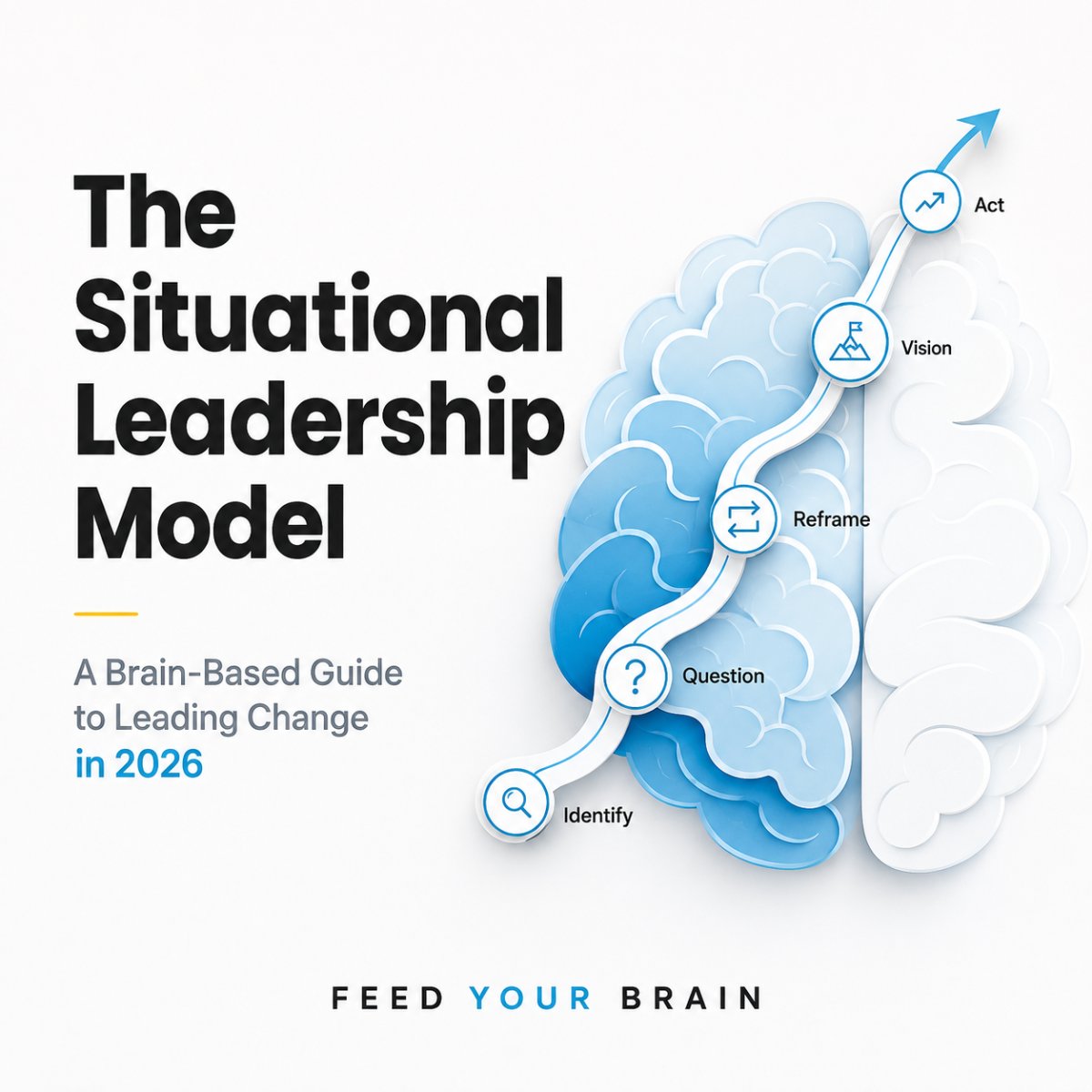
The Situational Leadership Model: A Brain-Based Guide to Leading Change in 2026
You gave two people the same instruction last week. One of them ran with it. The other went quiet, and you found out on Thursday that nothing had moved.
Nobody was being difficult. You gave the same thing to two people who needed different things, which happens constantly and is almost impossible to see in the moment.
I spent 18 years leading learning and development inside a Fortune 500 company, and the leaders who struggled most were rarely the ones with a bad style. They were the ones with one style. It worked, so they used it everywhere, and then they could not understand why it worked on Tuesday and failed on Wednesday.
This guide covers what the situational leadership model actually says, why adapting is harder than knowing you should, and what to do differently on Monday.
Key Takeaways
- The model sorts by task, not by person. Someone can be an expert at one thing and a beginner at the next, in the same week.
- Most of what any of us does at work runs on habit, which is why leaders default to one approach under pressure rather than choosing one.
- Under-leading a beginner and over-leading an expert are the same mistake, and both are common.
- Adapting your approach is not inconsistency. It becomes inconsistency only when you never explain it.
- AI has put experienced people back at the beginning of something, which is exactly the situation this model was built for.
What Is the Situational Leadership Model?
Situational Leadership® is a model developed by Paul Hersey and Ken Blanchard in the late 1960s, and the mark is owned by The Center for Leadership Studies, which Hersey founded. Blanchard later developed his own version, now trademarked separately as SLII®. It is not my framework and I do not teach it. I am referencing it here because it names something real.
The core claim is simple and was unusual at the time. There is no single best way to lead. The right amount of direction depends on the person in front of you and the specific task you are handing them, and both of those change.
What made it a break from what came before is where it points. Earlier thinking treated leadership as a fixed type, something you either had or did not. This moved the question onto the follower, and onto a specific piece of work rather than a personality. Not who you are. What they need.
That last part, what people need, is the piece most people lose. A senior developer can be at the top of their game writing code and completely at sea leading a client presentation. Same person, same week. Treat them as an expert in both and you will get a great sprint and a bad presentation.
Why Leaders Default to One Approach
Most leaders can explain the model. Far fewer adapt in the moment, and the reason is not that they forgot.
Between a third and half of what people do on a given day runs on habit rather than deliberate choice, according to Wood, Quinn and Kashy's diary research. That is not a criticism. It is what makes a workday survivable. It also means your leadership approach is a routine before it is a decision.
Choosing deliberately costs something. You are holding the task, the person, their track record and your own read on the risk, all at once, and working memory holds only about three to five things at a time under good conditions, per Cowan's 2001 review. A Tuesday afternoon with a deadline is not good conditions. So you do what you did last time.
This is why leaders over-direct in a crisis. It is the most familiar move, and familiar is cheap. It is also why the leader who tells you they treat everyone the same is usually describing a habit rather than a principle.
The fix is not more knowledge about the model. It is fewer decisions made on the fly. Decide your approach before the conversation, when you have room to think, rather than in the room when you do not.
The Four Approaches, and When Each One Fits
Hersey's model sorts leader behavior into four: telling, selling, participating and delegating. In plain terms, that is a spectrum from "here is exactly what to do" to "this is yours, come find me if you need me."
High direction, for genuinely new work. When someone has not done a thing before, specifics are not micromanagement. They are the difference between starting and stalling. Give the steps, check the work, and be available. As they find their footing, keep the direction but start explaining your reasoning, because the reasoning is what they will need when you are not there.
High autonomy, for people who have earned it. Some people have the skill and are hesitant anyway, and what they need is not instruction but a real conversation and your confidence. Others already know exactly what to do and need you to stop checking. That second one is where leaders get stuck, because letting go feels like the outcome is still yours and the control no longer is.
The two failure modes are mirror images. Leave a beginner to figure it out and they will spend more time worrying about looking incompetent than doing the work. Tell an expert how to do their own job and you have told them you do not trust them, whatever your words said.
Neither is a character flaw. Both are diagnosis errors, and diagnosis is a skill you can get better at.
Reading Readiness Without Guessing
The model asks you to judge two things about a person on a specific task: can they do it, and are they willing to. That gives you four rough situations, from new and unsure through skilled and ready.
I don't think sorting people into four situations is the useful part. The useful part is the discipline of asking about the task rather than the person, which sounds like a small distinction and changes every answer you get. "Is Maria good" is not answerable. "Has Maria run a client escalation before" is.
A few things can make the read more accurate:
Separate can from will. Someone hesitating might lack the skill, or might have the skill and no confidence, and those need opposite responses. Instruction given to a capable person who is nervous makes the nervousness worse.
Ask instead of inferring. "What part of this have you done before?" takes ten seconds and beats a guess. Most leaders skip it because asking feels like admitting they should already know.
Expect it to move. Readiness is not a rating someone carries. It changes with the task, and it changes when circumstances do. A capable person going through something hard at home is not the same person they were last year, and pretending otherwise helps nobody.
Your one small shift this week. Pick the person you are least sure about and ask them directly what part of their current work they would want more support on. Then do not argue with the answer.
Applying The Shift Method
Knowing the model and changing your behavior are different problems. This is where I use The Shift Method, which is mine: Identify, Question, Reframe, Vision, Act.
Identify. Name your default. Not the one you would claim. The one that shows up in a bad week, when the deadline moved, you’re hungry and tired.
Question. Ask whether the default is a judgment or a habit. The test is whether you can remember deciding. If you cannot, it was a habit wearing a decision's clothes.
Reframe. Move from "I have a leadership style" to "I have a set of responses, and I have been using one of them." A style feels like identity, and identity resists change. A set of responses is just a set of responses.
Vision. Pick one person and one task and decide what your approach should be, specifically, before the next conversation.
Act. Do it once, then again, past the point where it feels like effort.
That last step is where the research is clear. Gartner found that only 32% of mid-to-senior leaders said the last change they led was adopted in a healthy way, and 79% of employees reported low trust in change. Their finding is that inspiring people only works when change trust is already high. When it is low, which is now the normal condition, making the new behavior routine works better. Their model predicts three times the adoption.
Repetition is not the packaging around the change. It is the change. The NeuroLeadership Institute's own client data points the same way: employees felt 15% to 25% more equipped to apply a concept when their manager discussed it frequently rather than rarely. That is NLI's internal data rather than an independent study. The direction is the point.
How long this takes is variable. In Lally and colleagues' 2010 study, a new behavior took an average of 66 days to become automatic, with a range from 18 days to 254.
Where This Gets Hard Right Now
AI has done something specific to your team that nothing else in the last decade has. It has taken experienced, senior people and put them back at the start.
That is a readiness problem, not a training problem, and the numbers say most organizations are handling it as neither. Gallup's Q2 2026 tracker found 47% of U.S. employees say their organization has integrated AI tools, but only 25% say it has communicated a clear plan for them. Robert Half found just 35% of workers feel very confident using AI tools effectively.
So you have capable people, a tool they have not used, and no stated expectation. Delegate into that, and you are not granting autonomy. You are leaving someone to guess in public, in front of colleagues who think of them as the person who knows things, which is a risk most people manage by quietly doing nothing.
The move is not fancy. Be specific at the start. What should they use it for? What should they check. Then, once the mechanics are handled, the harder conversation: what this means for what they are good at. That second part is the one leaders skip, and it determines whether anyone actually uses the thing.
This is the work FYB | AI Confidence covers, and it is mindset rather than prompts. Not which tool to use. What it costs someone to be seen learning in front of people who think of them as the expert.
Adapting Is Not Inconsistency
The fear underneath all of this is that it looks like you have no principles. You give one person detailed direction and another almost none, and you worry it reads as favoritism or as flip-flopping.
It reads that way only when it is unexplained. Say the reason out loud: "You have run these before, so this is yours. I am staying closer to Dev on the escalation because it is his first." Nobody who hears that thinks you are inconsistent. They think you are paying attention.
What people actually experience as unfair is the opposite. One approach applied to everyone ignores what each person has earned, and the expert being managed like a novice notices long before you do.
So decide before the conversation, not during it. Ask what someone has done before rather than guessing. Say your reasoning out loud. Then keep doing it past the point where it feels deliberate, because that is when it starts working.
Frequently Asked Questions
What is the difference between situational leadership and servant leadership?
I see Situational Leadership® as tactical and task-specific. It answers what this person needs from you on this piece of work, right now. Servant leadership is a stance on your role. They aren't in conflict, and most good leaders do both, but they answer different questions, and only one tells you what to do in Thursday's meeting.
How do I know if I am micromanaging or giving appropriate direction?
Ask whether the person has done this specific thing before. Detailed direction is helpful for someone who hasn't done it before. The same direction to someone who has done it forty times is a message about trust, whatever you intended. When you are unsure, ask them which they would prefer and take the answer at face value.
What is the most common mistake leaders make with this model?
Diagnosing the person instead of the task. Once someone is filed as strong or weak, that label follows them into work they have never touched, producing both errors: the strong performer left alone with something they have never done, and the weaker one still supervised on work they mastered a year ago.
How long does it take to change how I lead?
Longer than a workshop and less time per day than you would think. Habit research puts the average at 66 days for a new behavior to become automatic, with enormous individual variation, so treat any specific promise with suspicion. What shortens it is deciding in advance rather than in the moment, and doing it in the same situation repeatedly rather than sporadically.
Is a model from the 1960s still relevant with AI?
AI has taken senior people and made them beginners again at something visible and public, which is exactly the situation the model was built to describe. The mechanics of the tools change constantly. The question of how much direction a capable person needs when they are new to something does not.
How do I handle someone who is expert at one thing and new at another?
Treat the tasks separately and say that you are doing it. The risk is letting seniority carry across, so that someone who has earned autonomy in their core work gets the same hands-off treatment on something they have never attempted, and reads your absence as an expectation that they should already know.
Will people think I am playing favorites?
Only if you never explain it. The reasoning is short, and it holds up: this person has done this before; that one has not. Say it in the room rather than letting people reconstruct it from the outside, which is where the favoritism story gets written.
Situational Leadership® is a registered trademark of The Center for Leadership Studies, Inc. SLII® is a registered trademark of Blanchard Training and Development, Inc. This article references these models to identify them and is not affiliated with, licensed by, or endorsed by either company.
Disclaimer
About this article. Tiffany Whitney is a NeuroLeadership-trained brain-based coach with 18 years of Fortune 500 Learning & Development leadership, and Amazon bestselling co-author of Strength with Kathy Ireland. Statistics are cited to primary sources; where a figure comes from an organization's internal data rather than independent research, that is noted in the text. This article is for educational purposes and is not medical, psychological, or clinical advice. AGES and SCARF® is a registered trademark of NeuroLeadership Institute, Inc. or its affiliates. Feed Your Brain is not affiliated with or endorsed by the NeuroLeadership Institute.