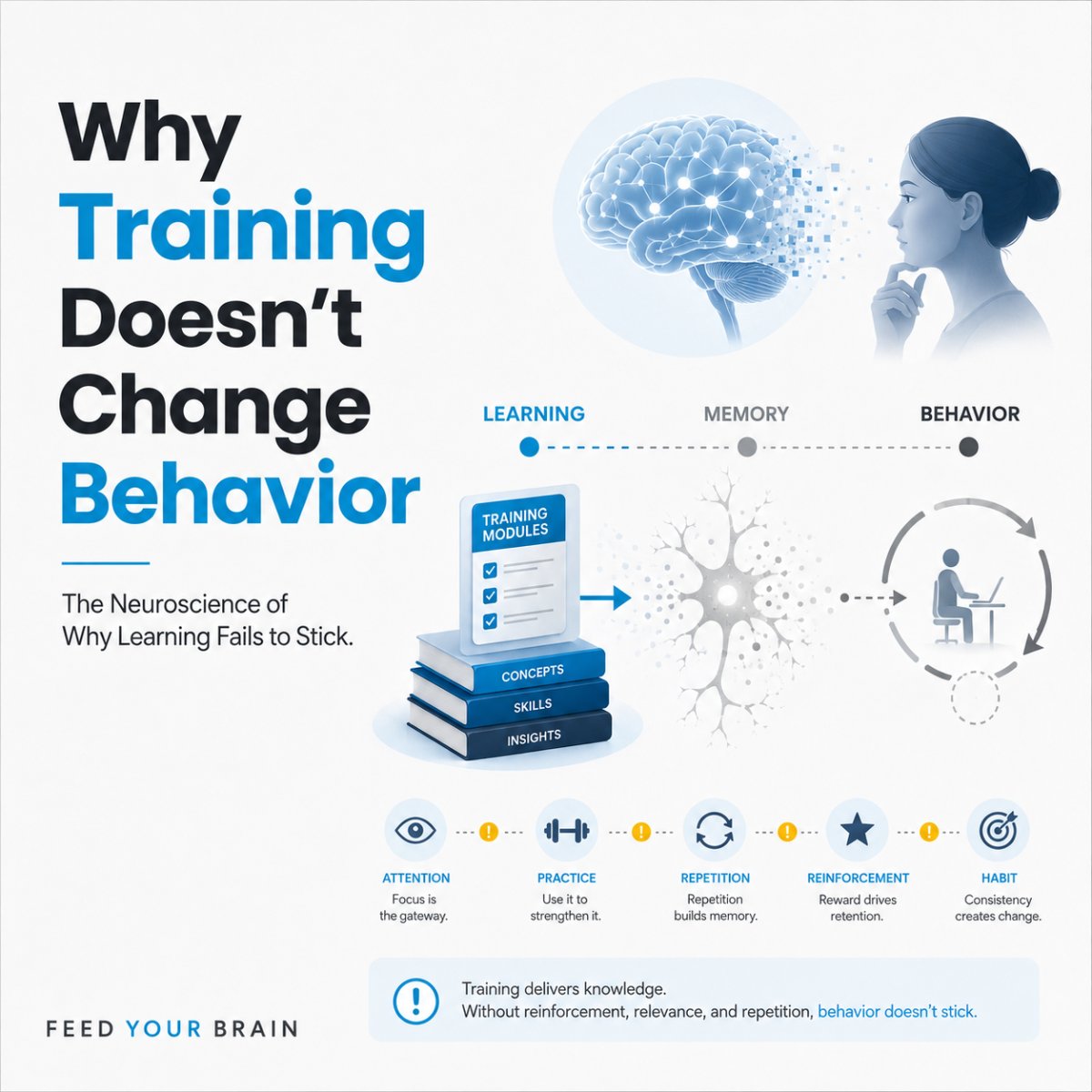
Why Training Doesn't Change Behavior: The Neuroscience of Why Learning Fails to Stick
U.S. companies spent over $102.8 billion on corporate training last year, and most leaders are still waiting for it to show up anywhere in the results. Your team sat through the slides. They nodded along. Then they went right back to their old habits. That's not a strategy failure, and it's not stubbornness. Their brains are doing exactly what brains are built to do.
Understanding why training doesn't change behavior means looking past the classroom and into how habits actually form. You've felt the sting of a training budget that didn't move the needle, or the exhaustion of pushing for AI adoption only to hit a wall of quiet compliance instead of real commitment. That's not a leadership failure. It's a biological one, and it's fixable once you understand what's actually happening.
I've spent 18 years bridging Fortune 500 experience with brain science, and here's what I've learned: the goal was never "teach more." It's build differently.
Key Takeaways
The brain prioritizes energy efficiency over new information, which creates a real, measurable gap between what employees know and what they actually do.
Training fails to change behavior when it only addresses conscious understanding and never reaches the deeper systems that run daily habits.
Two things quietly sabotage most corporate training: a lack of real-world context, and simply asking for too much at once.
Lasting behavior change comes from small, repeated practice and social modeling, not a bigger workshop.
AI adoption is an identity shift for many people, not just a technical upgrade, and it needs to be led that way.
The Training Gap: Why Understanding Isn't the Same as Changing
You've seen it a hundred times. Your team leaves a workshop energized, promising to use the new tools. They genuinely get it, intellectually. Three weeks later, the new CRM sits empty and the old spreadsheets are back in rotation. This is the Knowing-Doing Gap, and it's the primary reason why training doesn't change behavior in any lasting way. We consistently mistake understanding a concept for being able to apply it under pressure. Those are two very different skills.
Your team can ace a post-training quiz because the information got stored. Real work isn't a multiple-choice test, though. When Tuesday afternoon gets busy, the brain reaches for whatever's fastest, and fastest usually means whatever it already knows how to do. Unless training reaches the deeper habit-forming parts of the brain, the new information stays exactly that: information. It never becomes action.
Plenty of leaders get fooled by the energy in the room during a great workshop. That motivation is real in the moment, but it's not the same thing as a new habit forming. Without a plan to actually bridge that gap, the energy evaporates the second everyone's back at their desks.
Why a Great Workshop Can Still Fail
Passive learning creates a dangerous illusion of mastery. When a skilled facilitator makes something look easy, the room mistakes "this is easy to follow" for "this will be easy to do." Nodding along takes almost no effort. Real change requires actual habit formation, which takes repetition and a bit of real struggle. Agreeing with an idea is a spectator sport. Changing a behavior is closer to an endurance race.
Why One-and-Done Workshops Underperform
With U.S. corporate training spending north of $102.8 billion in 2025, the stakes here are genuinely high. Memory research consistently shows people forget roughly half of new information within an hour, and up to 70% within a day (Ebbinghaus, replicated by Murre & Dros, 2015, PLOS ONE). That's not corporate-specific data, but it tracks with what shows up in real teams: without reinforcement, information decays fast. A single workshop with no follow-up doesn't build anything. It's a donation to the status quo.
The Neuroscience of the Status Quo: Why the Brain Resists New Habits
Why does your team slide back to old habits within hours of a workshop ending? It isn't a willpower problem. It's a hardware conflict. Training speaks to the part of your brain responsible for conscious thought and logic. Daily behavior runs through an older, faster system built for automatic habits. That mismatch is a real reason why training doesn't change behavior. The thinking part of the brain is metabolically expensive to run. It tires fast. To save energy, the brain defaults to the habit system whenever it can, because that path is cheap and already built.
Change also registers as a mild threat. A new workflow isn't just a new process. It's uncertainty, and the brain treats uncertainty as risk, even when the risk is nothing more than a new piece of software. That response can put people into a subtle, low-grade defensive state, and in that state, high-level learning basically shuts down. The brain is busy scanning for safety, not absorbing new information. This is part of why training alone rarely drives real behavior change: the brain consistently prioritizes the familiar over the merely better.
Neuroplasticity is the real solution here, but it needs the right framing. You can't delete an old habit outright. What you can do is build a new pathway strong and repeated enough that it becomes the easier choice over time. If you want more on how to work with this instead of against it, The Rewire goes deeper into exactly this.
The Path of Least Resistance
The brain is relentlessly efficient. It builds autopilot pathways for anything routine, specifically to free up energy for everything else. When you ask a team to adopt something new, it feels clunky and frustrating at first, and that frustration is just the brain working harder than it wants to. Leaders often read that friction as laziness or a lack of buy-in. It's neither. It's a brain trying to get back to its most efficient state. To make change stick, the new behavior has to become easier to reach for than the old one.
Psychological Safety Isn't Optional
Learning is genuinely vulnerable. Trying something new means risking being visibly bad at it for a while, and the brain reads that as a real social risk. Without real psychological safety, the "safe" old way will keep winning over the "risky" new one. People need explicit permission to be clunky while they're learning. Validation isn't a soft leadership nicety here. It's what actually keeps someone's brain engaged enough to keep learning instead of quietly retreating to what already works.
Three Reasons Corporate Training Is Biologically Flawed
Most L&D models treat the brain like a hard drive: upload the data, expect the new behavior to run. But the brain is a biological system with real limits, not a computer. Ignoring that doesn't just waste a training budget. It quietly teaches people that change isn't worth the effort. This is the core reason why training doesn't change behavior on its own.
Reason 1: No real-world context. New skills are tied to the environment where they were learned. Practice something in a quiet conference room, and your brain won't automatically fire that skill back up at your actual, chaotic desk.
Reason 2: Too much at once. Working memory holds roughly four items at a time (Cowan, 2001), not the dozens most workshops try to deliver. Overload it, and very little sticks.
Reason 3: No immediate reward. The brain repeats what feels good, and quickly. If a new process feels clunky and the payoff is six months out, the old habit usually wins.
Learning Needs to Happen Where the Work Happens
New skills are context-dependent. They're anchored to a specific environment, and simulated settings like a training room often don't transfer well to the real one. Back at your actual desk, the familiar surroundings trigger the old habit before you've even had a chance to think about it. Training works better inside the actual flow of work. The closer the practice is to the real task, the more likely the new behavior is to activate when it actually matters.
Close the Reward Gap
In most corporate change efforts, the payoff for the new behavior is too far in the future to mean much day-to-day. The brain needs faster feedback to actually cement a new habit. Micro-wins solve this: small, visible signals of progress that tell the brain to keep going. Without them, the pull back to the old, familiar routine usually wins.
A Framework That Actually Sticks
Moving from agreement to real results means treating training as an ongoing process, not a single event. I lean on The Shift Method here, five steps that map onto how behavior change actually works biologically:
Identify the specific behavior you're targeting and the cue currently triggering the old one.
Question whether the resistance is really about the task, or about something else, like a loss of control or unfamiliarity.
Reframe the new behavior around what it actually makes possible, not just what it demands.
Vision a clear picture of what success looks like, concrete enough to work toward.
Act through small, repeated practice, paired with modeling from people your team already trusts, and cues built right into the actual workspace, not just the training room.

From Content Delivery to Real Habit Integration
Leaders need to move from being messengers of new policy to being architects of the environment people actually work in. That means shifting focus from what people know to how they act. One genuinely useful tool here is if-then planning, a well-documented technique where you pre-decide your response to a specific trigger: "If I feel overwhelmed by a new AI tool, then I use the quick-start guide instead of reverting to the old manual process." That kind of tactical planning is a regular part of how Feed Your Brain | Consulting approaches this work.
Behavior Is Contagious
People consistently pick up on what's actually being modeled around them, not just what's being said. That's why a leader's quiet hesitation about a new tool carries more weight than any training course. If you're not using it yourself, your team notices, and their own resistance gets easier to justify. Building a culture of curiosity instead of top-down compliance lowers the cost of change across the board. When curiosity is the default, something new reads as an opportunity instead of a threat.
The AI Adoption Case Study: Why Leaders Feel Behind
AI isn't just another software update for a lot of people. It can feel like a direct challenge to identity and expertise built over years. For someone with real, hard-earned experience, a tool that generates a strategy in seconds can feel less like a productivity gain and more like a threat. This is a big part of why training doesn't change behavior in the AI era specifically. If a tool feels like a replacement for someone's value, the resistance that follows isn't stubbornness. It's protection.
That protection often shows up as a quiet fear of looking incompetent. Gallup's 2026 workplace data shows 47% of employees say their organization has integrated AI tools, but only 25% say leadership has actually communicated a clear plan for how to use them, meaning roughly three in four employees are navigating this without real guidance. That ambiguity creates real, ongoing stress. When people feel behind, they stay on alert, and you cannot absorb a new workflow while part of your attention is busy scanning for a way to save face. Learning needs a settled state that pure technical instruction can't provide on its own.
Rewiring for the Future of Work
Non-technical leaders are often the most vulnerable to this exact trap: treating AI as a technical hurdle instead of a behavioral one. Moving from AI literacy to real AI confidence means lowering the stakes first. FYB | AI Confidence is built around exactly this shift, using low-stakes, high-reward practice to build a new pathway based on agency instead of anxiety. For ongoing, brain-based support, The Rewire delivers the kind of reinforcement that actually makes a new habit permanent.
Your Next Step Toward Change That Sticks
The era of training as a single event is over. It worked in a slower world, where understanding something was close enough to doing it. Today, that gap is too expensive to ignore. Behavior runs on an automated system, not a conscious choice made fresh every time. To actually shift your organization, you have to become an architect of the environment people work in, not just a messenger of new policy. Stop fighting the biology. Start building with it.
Move Beyond the Classroom
You've felt the frustration of a serious training investment producing zero real shift. Now you know why. Your team isn't being stubborn. Their brains are just prioritizing energy-efficient habits over "expensive" new information, exactly like they're built to. Real results come from architecting the environment for repetition and reward, not delivering more content.
I've spent 18 years leading L&D at the Fortune 500 level, and I'm an Amazon bestselling co-author of Strength, alongside my certification as a Brain-Based Coach through the NeuroLeadership Institute. Real change happens at the intersection of theory and biology, not from more slide decks. You have the ability to end the cycle of one-and-done workshops and build something that actually evolves.
Ready to make change stick? Explore Feed Your Brain | Consulting and FYB | AI Confidence.
You're not behind. You're just ready for a better way to lead. Let's start building it.
Frequently Asked Questions
Why do employees go back to old habits after training?
They revert because the brain defaults to energy-efficient, automatic routines the moment real-world stress returns. That's the core biological reason why a single training event rarely changes behavior on its own. Breaking the cycle takes cues that trigger the new behavior inside the actual flow of work, not just inside the training room.
How long does it actually take to change behavior at work?
Habit research puts the average around 66 days, with a wide range depending on complexity, roughly 18 to 250 days (Lally et al., 2010). The old "21 days" figure is a myth with no research behind it. What actually matters more than any specific number is consistent repetition in the real context where the behavior needs to happen.
Can neuroscience actually improve change management ROI?
Yes, mainly by explaining why training fails when it skips reinforcement entirely. Understanding that memory decays fast without repetition (Murre & Dros, 2015) shifts the investment from paying for seat time toward paying for behavior that actually sticks. That's the real ROI lever most training budgets are missing.
What's the difference between learning and behavioral change?
Learning is acquiring information. Behavioral change is that information becoming automatic enough to hold up under real pressure. You can learn a new CRM in an hour. Actually using it consistently when you're busy is a different, physical skill entirely. Real change takes repeated practice, not just a good explanation.
How can I tell if training is actually working?
Watch daily behavior, not quiz scores. If your team passes the test and still reaches for the old spreadsheet, the training didn't take. Real success looks like people choosing the new process on their own, without a supervisor or checklist prompting them to.
What should I do if my team is resistant to AI adoption?
Start by naming the fear underneath it, usually a fear of being replaced or looking behind, rather than treating it as a skills gap. Give people low-stakes ways to practice without real consequences attached. Lowering the perceived threat is what actually opens the door to building real confidence with the tool.
How do I create a learning environment that actually works with the brain?
Prioritize psychological safety and spaced repetition over one big event. Respect the real limits of working memory by breaking things into small pieces, and build in visible wins along the way. When people feel safe and see a clear, near-term benefit, they're far more likely to stick with the harder work of building a new habit.

Article by
Tiffany J. Whitney