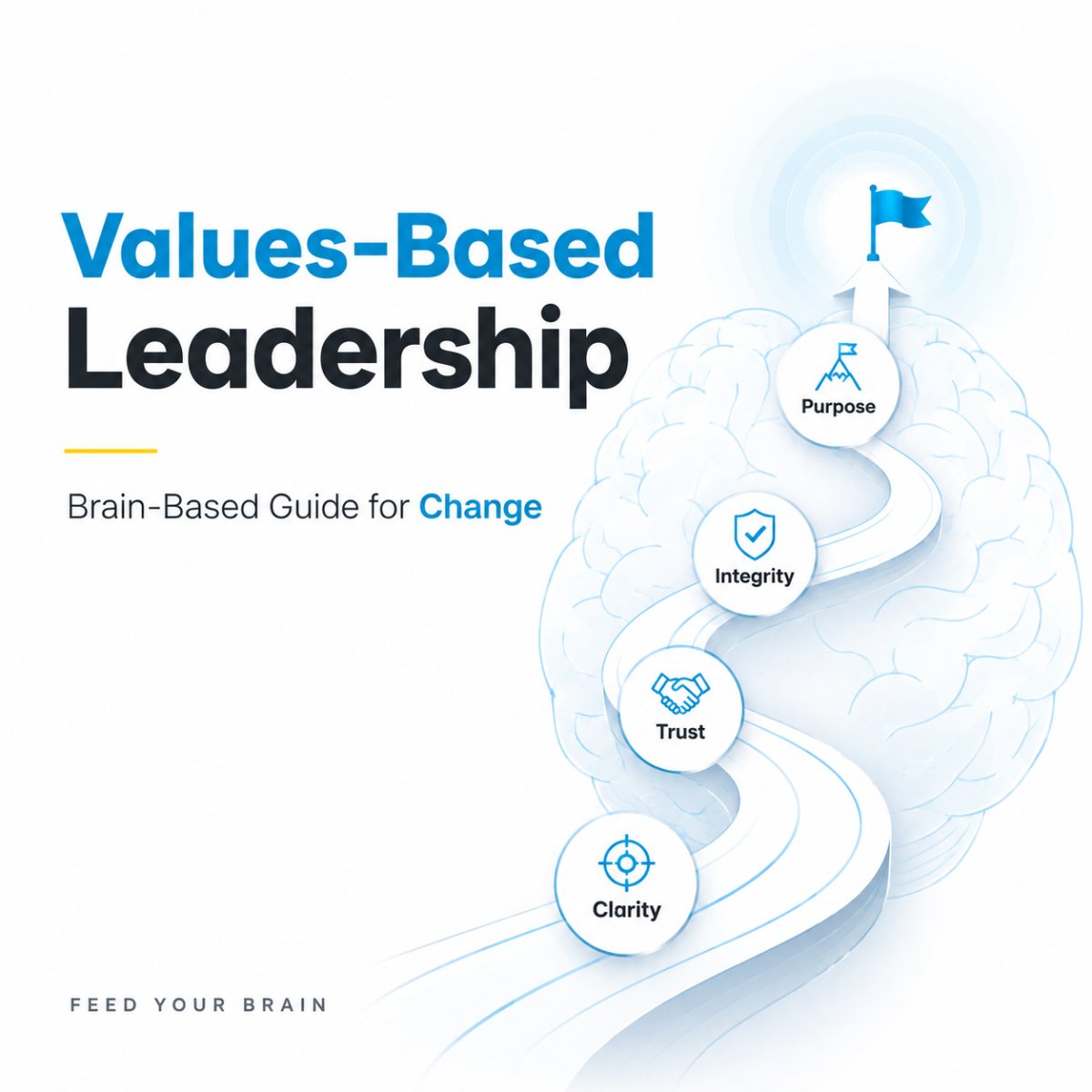
Values-Based Leadership: Brain-Based Guide for Change
You have seen it happen. An initiative starts strong, the kick-off goes well, and then six weeks later everything is running the way it always ran. The values are still on the wall. They are just not in the room when the deadline hits.
I spent 18 years leading learning and development inside a Fortune 500 company, and I watched this pattern repeat for most of them. The instinct is to blame attitude. People are resistant. People do not want to change. That read is comfortable, and it is almost always wrong. What people are actually doing is protecting themselves from unpredictability, and they do it faster than they can think about it.
Values-based leadership for change works when it gives people something that does not move while everything else does. Not a slogan. A filter they can predict you will use. This guide covers how to build that filter into daily behavior, why most values rollouts fail before the first quarter ends, and what to change on Monday.
Key Takeaways
- Uncertainty costs people real performance, and predictable leadership is one of the few things that reliably lowers it.
- Most values programs die in the gap between knowing the value and using it under pressure.
- Repetition is not a communication failure. It is the mechanism. Managers who keep talking about a concept get measurably different results than managers who announce it once.
- Behavior follows the environment. If the cue stays the same, the old routine comes back regardless of what anyone believes.
What Is Values-Based Leadership for Change?
Values-based leadership is the practice of using a small set of stated principles as the visible filter for decisions, especially the hard ones. It is less about the "what" of a transformation and more about the "how" people experience it.
According to James O'Toole, who put the phrase into wide circulation with Leading Change: The Argument for Values-Based Leadership in 1996, values are what let you pull change rather than push it, and resistance is usually people protecting a comfort the change threatens. That was written thirty years ago and it has aged well. What I would add is the part he could not have known, which is what the pushing costs now that the changes never stop.
The reason it matters right now is volume. Gartner found that the average employee went through two planned enterprise changes in 2016 and ten in 2022. Over that same stretch, willingness to support change fell from 74% to 43%. Nobody got lazier. They got saturated. When the changes keep stacking, the only thing that helps is knowing how the person leading them will behave.
The Difference Between Values and Posters on the Wall
Most corporate value statements fail because they stay trivia. People can recite them in orientation and cannot use them in a budget meeting. There is a real distance between the values a company states and the values it runs on, and everyone can see it.
The tell is what happens under pressure. A leader who chooses speed over transparency once has not broken a rule. They have answered a question their team was quietly asking: is this list real, or is it decoration? People calibrate off that answer for months.
Why Values Matter More During Change
Certainty is one of five things David Rock and the NeuroLeadership Institute identified as driving how people respond socially at work, in the SCARF® model: status, certainty, autonomy, relatedness, fairness. During a transformation, certainty is the one you cannot give people about the outcome. You can give it to them about you.
That is the whole move. Your team does not need to know how the reorg ends. They need to know that when the news is bad, you will say so on Friday, because you always have. When they cannot predict you, they spend the week reading you. Who said what in that meeting, what your tone meant on Tuesday, whether to raise the problem now or wait until you seem receptive. That is real work time, and it is going into guessing.
Why Values-Based Change Initiatives Fail
Not for lack of vision or budget. They fail because values get treated as information to be delivered rather than behavior to be practiced.
The Trap of the One-Time Rollout
The usual shape is a deck, a workshop, and a wallet card. Then everyone returns to a desk where nothing has changed. Not one cue, not one meeting, not one incentive. Knowing the value and using it are separate skills, and only one of them was trained.
Memory research is clear about what happens next. Memory work replicated by Murre and Dros in 2015 found roughly half of new material gone within an hour, and about 70% within a day, with no retrieval in between. Not because people are careless. Because material you never pull back out does not stay available. A values session with no follow-up is a session you paid for twice: once to run, once to run again next year.
The Environment Beats the Intention
Between a third and half of what people do on a given day runs on habit rather than deliberate choice, according to Wood, Quinn and Kashy's diary research. That is not a criticism of anyone. It is what makes a workday survivable.
It also means your team's behavior is downstream of the cues in front of them. If inclusion is a value but the meeting still opens with the most senior person talking for eleven minutes, the meeting has taught the room what to do. The stated value never gets a turn.
Leaders Quit Repeating Right Before It Works
This is the most common one, and the most expensive. A leader says the thing three times, decides everyone has it, and moves on.
The NeuroLeadership Institute's own client data points at what repetition buys you. Employees felt 15% to 25% more equipped to apply a concept when their managers discussed it frequently, compared with managers who mentioned it rarely. This is NLI's internal data rather than an independent study, so treat the size of the effect as directional. The direction is what matters here: the repetition is not the packaging around the intervention. The repetition is the intervention.
Applying The Shift Method to Values-Based Leadership
I run this through The Shift Method, which is the same five steps I use for every kind of behavior change: Identify, Question, Reframe, Vision, Act. Here is what each one looks like when the target is your own leadership behavior during a transformation.
Identify. Name what actually happens on your worst week, not your best one. When the deadline compressed last quarter, what did you cut first? That is your operating value, whatever the wall says.
Question. Ask whether the gap is a belief or a constraint. "I could not be transparent about the restructure" is sometimes true and sometimes a story. Look for the evidence either way, because the fix is different.
Reframe. Move from "we need to communicate our values better" to "people learn my values by watching which trade-offs I make." Communication is not the lever. The trade-off is.
Vision. Decide what you want someone on your team to say about how you led this change, in a meeting you are not in. Write the sentence. It should be specific enough that someone could disagree with it.
Act. Pick one value and one repeated behavior that proves it, and do it long past the point where it feels redundant to you. If the value is empowerment, ask "what do you recommend?" before you answer, in every one-on-one, for a quarter.
That last step is where most of this lives, and Gartner's research points the same direction from a different angle. Only 32% of mid-to-senior leaders said the last change they led was adopted in a healthy way. In the same research, 79% of employees reported low trust in change. Gartner's finding is that inspiration only works when change trust is already high. It is not high. When trust is low, which is now the normal condition, routinizing change works better, and their model predicts employees are three times more likely to adopt change on time and in a healthy way when leaders make it routine rather than exciting.
That is an uncomfortable read for anyone who likes the kick-off. It is also good news, because routine is cheaper than a big speech and you can start it Monday.
Scaling It Past Yourself
One committed leader does not move an organization. Middle managers do, because they are where the message either repeats or stops. That is also where the difference between leadership and management stops being an abstraction. Managing the rollout is running the process. Leading it is repeating the value out loud until people can predict it. If your managers cannot say the value in their own words and point to a decision it changed, the rollout ended at their level. The front line never heard it.
Give them the language and the permission to use it in small moments rather than a script for a formal cascade. If you want structured help designing that, this is the work I do through Feed Your Brain | Consulting.
Your one small shift this week. Choose one repeated behavior that proves your top value and commit to it for the full quarter, not the week. Then tell your team what you are doing and why, so they can hold you to it.
Stop Managing Resistance. Start Making It Routine.
Resistance is rarely the real problem. Unpredictability is, and it is one of the few things a leader has direct control over.
So stop treating values as a message to be delivered and start treating them as a pattern people can predict. Say the value more times than feels necessary. Change the cue in the room before you change the language in the deck. Make the choice that proves the value when it costs you something, because that is the only version anyone believes.
Want the weekly version of this? The Rewire is my newsletter for leaders working through change and AI at the same time. One idea, one move, every week.
Frequently Asked Questions
How do leadership values actually affect organizational change?
They give people something predictable to navigate by while everything else moves. Certainty is one of the five drivers in the SCARF® model, and during a transformation you cannot offer certainty about the outcome. You can offer it about your own behavior. When a team can predict how their leader will handle bad news, they stop spending energy guessing and start spending it on the work.
Why do employees resist change even when they agree with the values?
Because agreement and behavior run on different tracks. Between a third and half of daily behavior is habitual rather than deliberate, so if the cues in someone's environment have not changed, the old routine keeps winning no matter what they believe. Every time. Resistance is often just the environment doing what it was built to do.
Can values-based leadership be taught, or is it an innate trait?
It is learnable, and it is mostly practice rather than personality. The skill is noticing which trade-off you make under pressure, then choosing a different one often enough that it becomes your default. That is repetition, not temperament.
What is the difference between leadership values and corporate culture?
Values are what you signal. Culture is what accumulates after you signal it consistently for a long time. Culture is the collective habit; values are the individual inputs that create it. You cannot edit the culture directly, which is why leaders who try to announce a new one rarely get anywhere.
Why does change fail so often even with good communication?
Because communication was never the constraint. Gartner found only 32% of leaders said their last change was adopted in a healthy way, and 79% of employees have low trust in change. In that environment, inspiring people works poorly. Making change routine, so that adopting it is the ordinary way work gets done, works considerably better.
How can I measure the impact of values-based leadership on my team?
Watch the speed of decisions when the pressure is on. If people default to the shared value without checking, it is wired in. If they wait for permission, it is not. You can also track how often the value gets named by someone other than you, which is the clearest sign it made it past your own level.
How do I start if my company's culture is resistant?
Start inside your own team, where you control the cues. Filter one visible decision through one stated value and say the filter out loud while you do it. Repeat until it is boring. A consistent signal from a direct manager builds a pocket of predictability, and pockets are how this spreads.
Disclaimer
About this article. Tiffany Whitney is a NeuroLeadership-trained brain-based coach with 18 years of Fortune 500 Learning & Development leadership, and Amazon bestselling co-author of Strength with Kathy Ireland. Statistics are cited to primary sources; where a figure comes from an organization's internal data rather than independent research, that is noted in the text. This article is for educational purposes and is not medical, psychological, or clinical advice. AGES and SCARF® is a registered trademark of NeuroLeadership Institute, Inc. or its affiliates. Feed Your Brain is not affiliated with or endorsed by the NeuroLeadership Institute.
Disclaimer
About this article. Tiffany Whitney is a NeuroLeadership-trained brain-based coach with 18 years of Fortune 500 Learning & Development leadership, and Amazon bestselling co-author of Strength with Kathy Ireland. Statistics are cited to primary sources; where a figure comes from an organization's internal data rather than independent research, that is noted in the text. This article is for educational purposes and is not medical, psychological, or clinical advice. AGES and SCARF® is a registered trademark of NeuroLeadership Institute, Inc. or its affiliates. Feed Your Brain is not affiliated with or endorsed by the NeuroLeadership Institute.